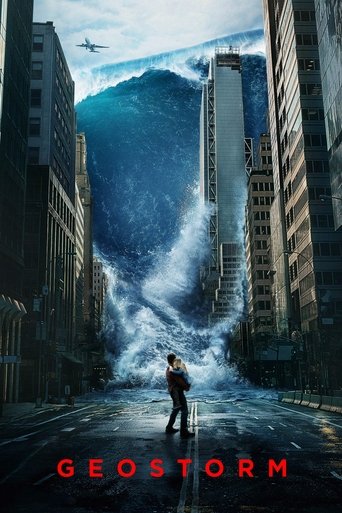
Same Year, Same Sky Falling
It's 2026, and we're still sorting through the wreckage of 2017 — a year that, by our records, delivered not one but two apocalyptic weather epics within months of each other. On one side: Geostorm, a satellite-network disaster movie with a reported budget north of $120 million, big-studio polish, and a cast racing against a man-made climate machine gone rogue. On the other: Geo-Disaster, a leaner, scrappier take where a chunk of dark matter punches through the Earth and turns a quiet LA morning into quakes, eruptions, and a family trying to find each other through the chaos.
Here at Mockbusters.tv, we have a long-running (and very tongue-in-cheek) house bit: we like to pretend the smaller, faster productions are the "originals" and the big-budget versions are the "million-dollar copies" that came along to cash in. It's a joke, not a historical claim — nobody is suggesting Hollywood accountants were taking notes from a dark-matter thriller. But it's a fun lens, and frankly, Geo-Disaster earns the bit on charm alone.
The Premise Showdown
Geostorm's pitch is pure engineering anxiety: humanity builds a climate-controlling satellite grid to stop natural disasters, and then the grid itself becomes the disaster. It's a story about systems — governments, orbit, control rooms, an engineer flying back into space to debug the literal sky. Per the catalog synopsis, the stakes escalate from freak temperatures to a planet-wide geostorm, with brothers working the problem from both space and ground.
Geo-Disaster skips the bureaucracy entirely. No committee, no satellite network, no press conference about global cooperation — just a stray piece of dark matter deciding Los Angeles has had it too easy. The result is quakes, eruptions, and "a sky nobody wants to look at," as our own synopsis puts it. Where Geostorm is a thriller about infrastructure, Geo-Disaster is a story about a family trying to physically find each other while the ground stops cooperating. Same genre, wildly different budgets, and — appropriately — wildly different scales of chaos management.